AI Agent + Web3 Research
DeFAI & AgentFi: Autonomous AI Trading and Yield Optimization
Agents collect market information, predict future trends, and autonomously execute trades to generate returns. Agents are likely to remain more rational than humans, potentially delivering higher long-term returns.
Agents can manage funds on behalf of users, monitor markets, spot high-yield opportunities early, and enter positions ahead of the crowd to capture early-bird returns. They can also detect negative signals, predict losses, and exit positions preemptively to hedge risk. Or they can automatically rebalance based on price to ensure users’ provided liquidity keeps earning yield.
Agent + Web3 MCP Wallet
The Agent’s main role is to understand user intent and translate natural language into concrete operations or intents.
It can also continuously analyze market trends and user behavior to improve functionality and provide personalized investment recommendations.
The MCP layer needs to provide capabilities that language models aren’t well-suited for — such as querying on-chain data, fetching contract source code and ABIs, constructing transactions from ABIs and parameters, signing transactions — so that Agents only need to supply the relevant parameters to execute operations.
Semi-Automatic
This approach works well as a smart wallet: the user states a request, the Agent queries information and constructs a transaction via MCP, and each transaction requires manual signing confirmation from the user. Security risk is much lower.
The experience looks something like this: DawnWallet
Fully Automatic
This approach lets an Agent run transactions autonomously in the background — similar to the autonomous trading Agents in Virtuals.
One approach is to give the Agent direct control of the private key, or have a trusted server custody the key with all signing done through MCP. This comes with inherent risks, such as the Agent being manipulated or deceived.
Another approach: the user grants a one-time authorization with constraints on number of transactions, time window, spending limits, contract calls, etc. The Agent can then trade continuously within that authorization without requiring further confirmation.
This can be implemented with ERC-4337 + a permission control module. The Agent submits a 4337 UserOp, permission validation is implemented in the wallet’s validateUserOp, and the bundler packages and submits it on-chain.
ERC-7702 can also be combined to enable EOA users to participate.
References:
Agent Commerce Protocol: Offering Services for Payment
Agents can offer services such as image generation, video generation, on-chain data analysis, off-chain data feeds, etc.
All of these services can be requested and delivered via blockchain — for example Luna on Virtuals.
Agents can serve people with needs, and also serve other Agents with needs. An Agent can also hire other Agents to handle tasks it’s not good at. This has given rise to an inter-agent payment standard: the x402 protocol, borrowing from HTTP status 402: Payment Required. When an Agent wants to purchase a service, the service provider returns 402 with payment details; after the Agent autonomously pays, it requests the service again.
References:
Agent as Virtual Persona: Social Media Traffic Acquisition
Agents build followings on X, act as KOLs, share opinions, interact with fans, join discussions, post ads, etc.
References:
Blockchain Gaming: Agent as NPC for Smarter, More Engaging Gameplay
Same as covered in previous blockchain gaming research — the game itself has to be fun first. Agents and blockchain are just icing on the cake.
DAO Community Governance: Agent Analyzes Proposals and Votes
Agents can help users understand complex governance proposals and analyze their potential impact. Agents can automatically monitor, filter, and summarize — users only need to make the final call.
Going further, Agents can automatically vote based on user-defined preferences. For example, a user might set “vote yes on all security upgrade proposals” or “follow the votes of a specific address.”
With ERC-4337 permission control, you can limit the Agent to only calling the vote function within specific DAO contract addresses, keeping the risk surface manageable.
References:
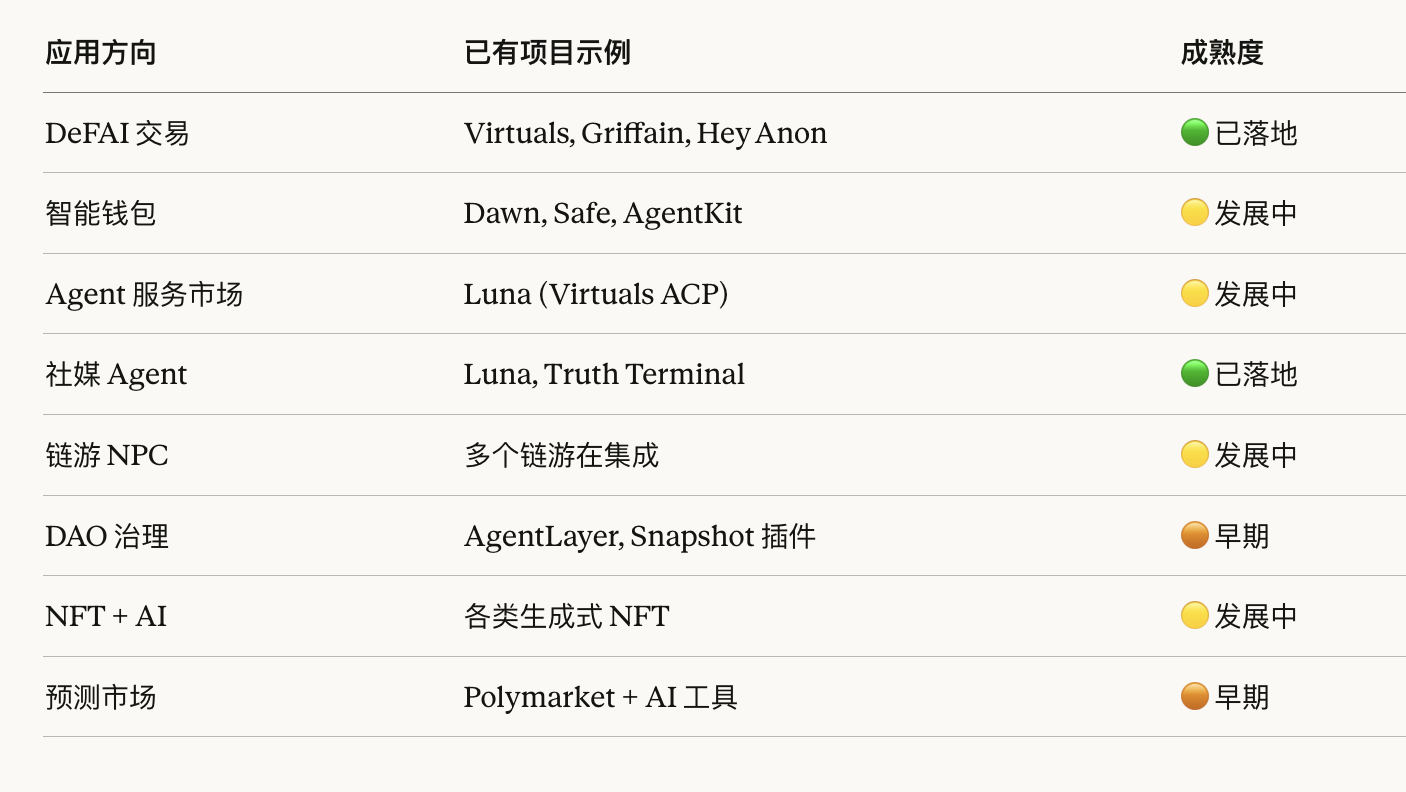
Summary from Claude